
If this is your first Umrah, you are probably carrying two feelings at once: enormous excitement and a quiet worry that you will get something wrong. This guide walks through the rites in the order you will perform them, in plain English, so that when you arrive you can concentrate on worship rather than logistics.
One note before we start. Umrah is simple at its heart, but details of fiqh vary slightly between the schools of thought, which is exactly why your group travels with a scholar or experienced guide. Below we describe the mainstream, widely accepted position. If your group's scholar advises something different, follow them.
What Umrah actually consists of
Umrah has four essential components. You enter the state of ihram with the intention of Umrah, perform tawaf around the Kaaba, perform sa'i between the hills of Safa and Marwah, and finally shave or trim the hair (halq or taqsir). Everything else is preparation, etiquette or recommended extras. Umrah can be performed at any time of year and usually takes two to four hours inside the Haram, depending on crowds.
Step 1: Preparing before you leave the UK
Good Umrah starts at home. Learn the short supplications you will actually use, settle any debts or disputes you can, and make sincere tawbah. Pack your ihram in your hand luggage, because most pilgrims from the UK enter ihram on the plane or at the airport. Our packing list covers the practical side.
Step 2: The miqat and entering ihram
The miqat is a boundary around Makkah that a pilgrim must not cross without being in ihram. Flights from the UK into Jeddah cross a miqat in the air, so the cabin crew or your group leader will usually announce when it is approaching. If you fly into Madinah first, you will enter ihram later at Dhul Hulayfah (known locally as Abyar Ali), just outside Madinah, on the way to Makkah. Many groups prefer this because it is far calmer than changing on an aircraft.
How to enter ihram
- Ghusl (a full bath) is recommended before ihram, along with trimming nails. Men may apply perfume to the body, not the garments, before the intention is made.
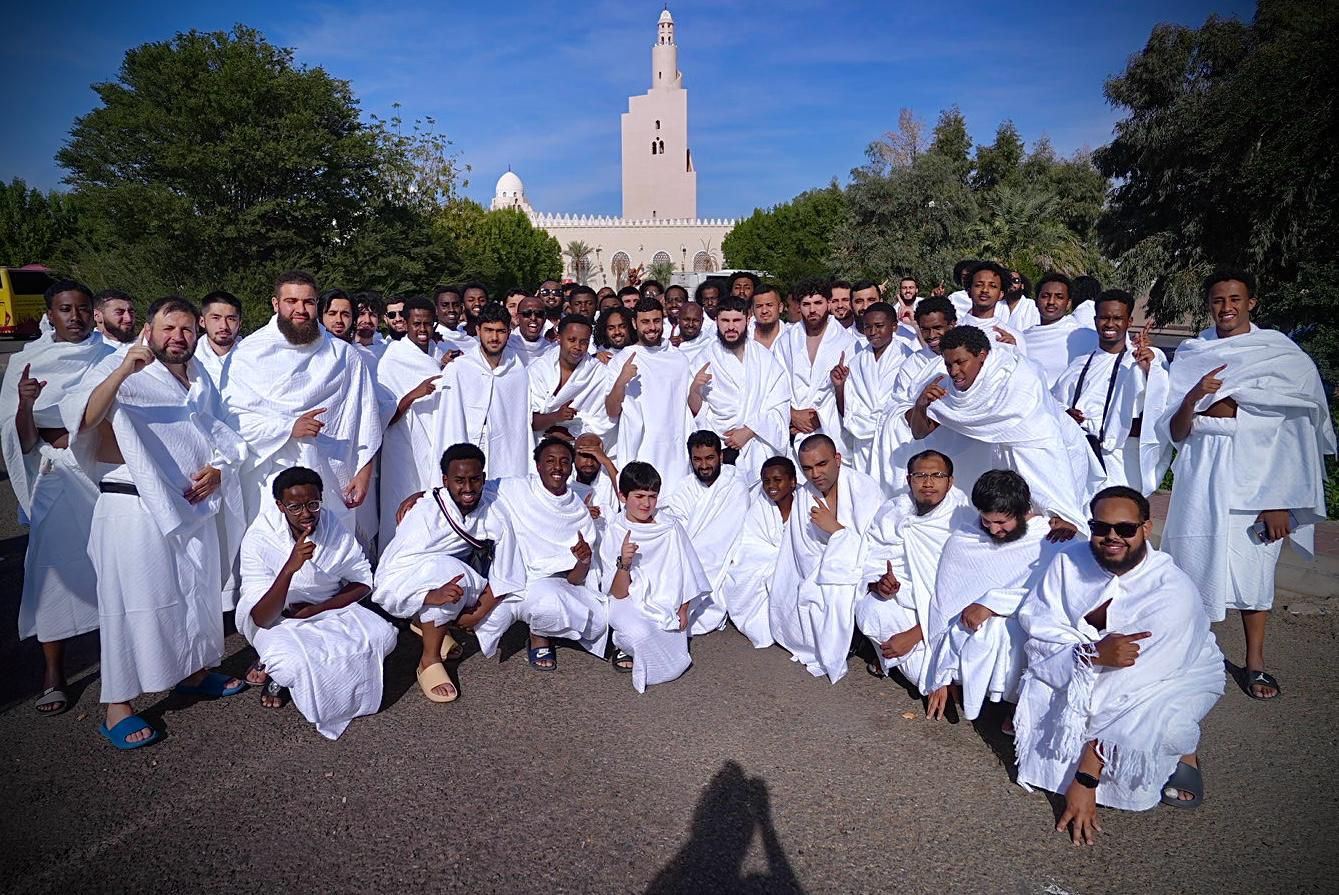
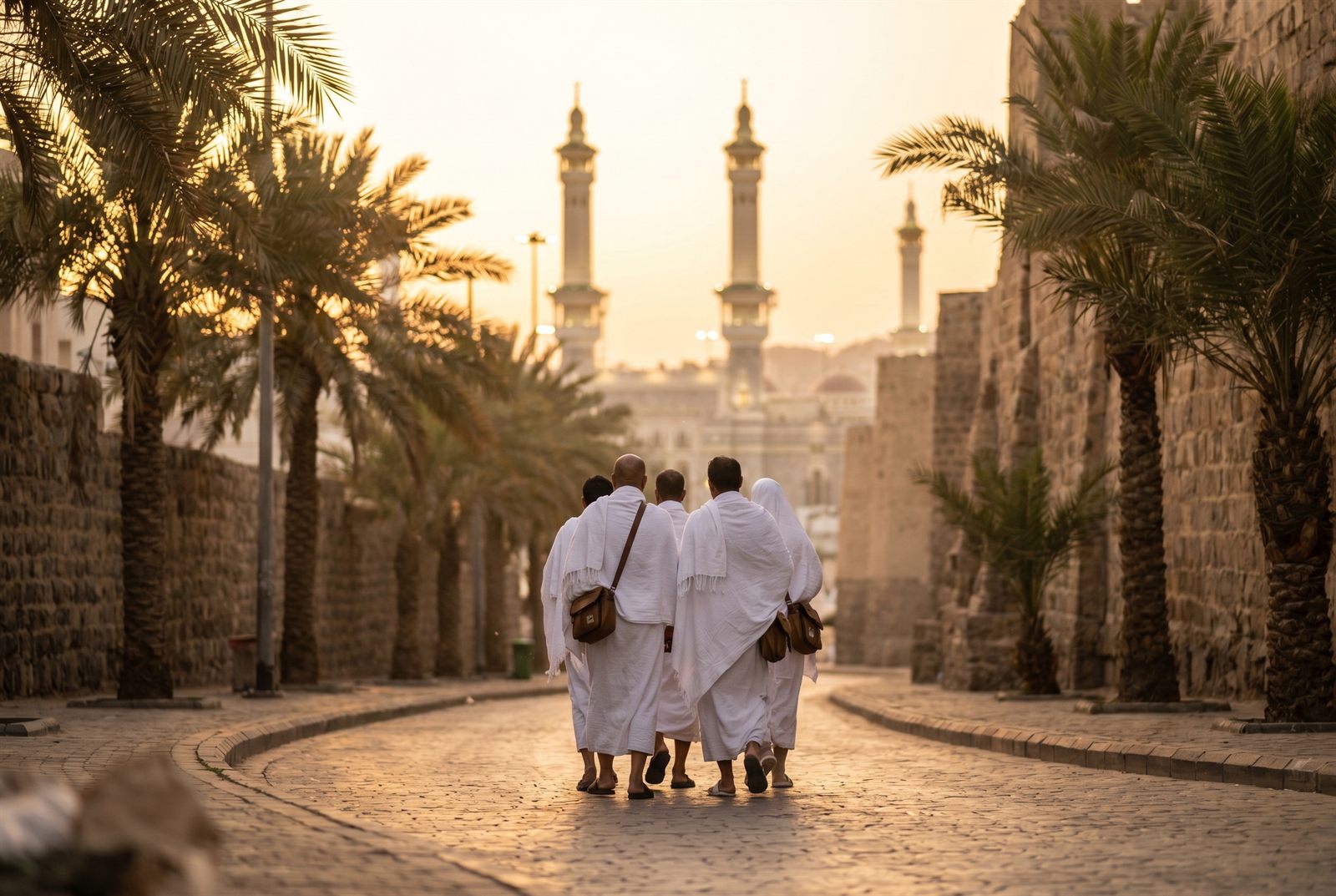
- Men wear two plain, unstitched white cloths: the izar around the waist and the rida over the shoulders. No underwear, no stitched garments, and the head stays uncovered. Sandals that leave the ankle exposed are fine.
- Women wear ordinary, modest clothing. There is no special colour or garment. According to the majority of scholars, a woman in ihram does not cover her face with a niqab that touches the face, nor wear gloves; your scholar can advise on how this is handled in crowds.
- Pray two rak'ahs if it is not a disliked time, then make the niyyah (intention) in your heart and say it: Labbayk Allahumma 'Umrah. From this moment you are a muhrim.
What becomes prohibited in ihram
Once in ihram you avoid: cutting hair or nails, perfume and scented products (including scented soap and wet wipes), marital relations, hunting, arguing and bad language, and, for men, covering the head and wearing stitched clothing. If you forget and slip, do not panic; tell your guide, who will explain whether anything is owed.
Step 3: The talbiyah
From the moment you enter ihram until you begin tawaf, recite the talbiyah often, especially after prayers, when climbing or descending and when meeting other pilgrims. Men raise their voices; women say it quietly:
Labbayk Allahumma labbayk. Labbayka la sharika laka labbayk. Innal-hamda wan-ni'mata laka wal-mulk. La sharika lak. "Here I am, O Allah, here I am. Here I am, You have no partner, here I am. Truly all praise, favour and sovereignty are Yours. You have no partner."
Step 4: Entering Masjid al-Haram
Enter with your right foot, saying the du'a for entering a mosque. Many guides suggest keeping your eyes down until you reach the mataf (the open courtyard) so that the first sight of the Kaaba is undistracted. When you see it, raise your hands and make du'a. There is no fixed supplication; ask for what is in your heart.
Step 5: Tawaf
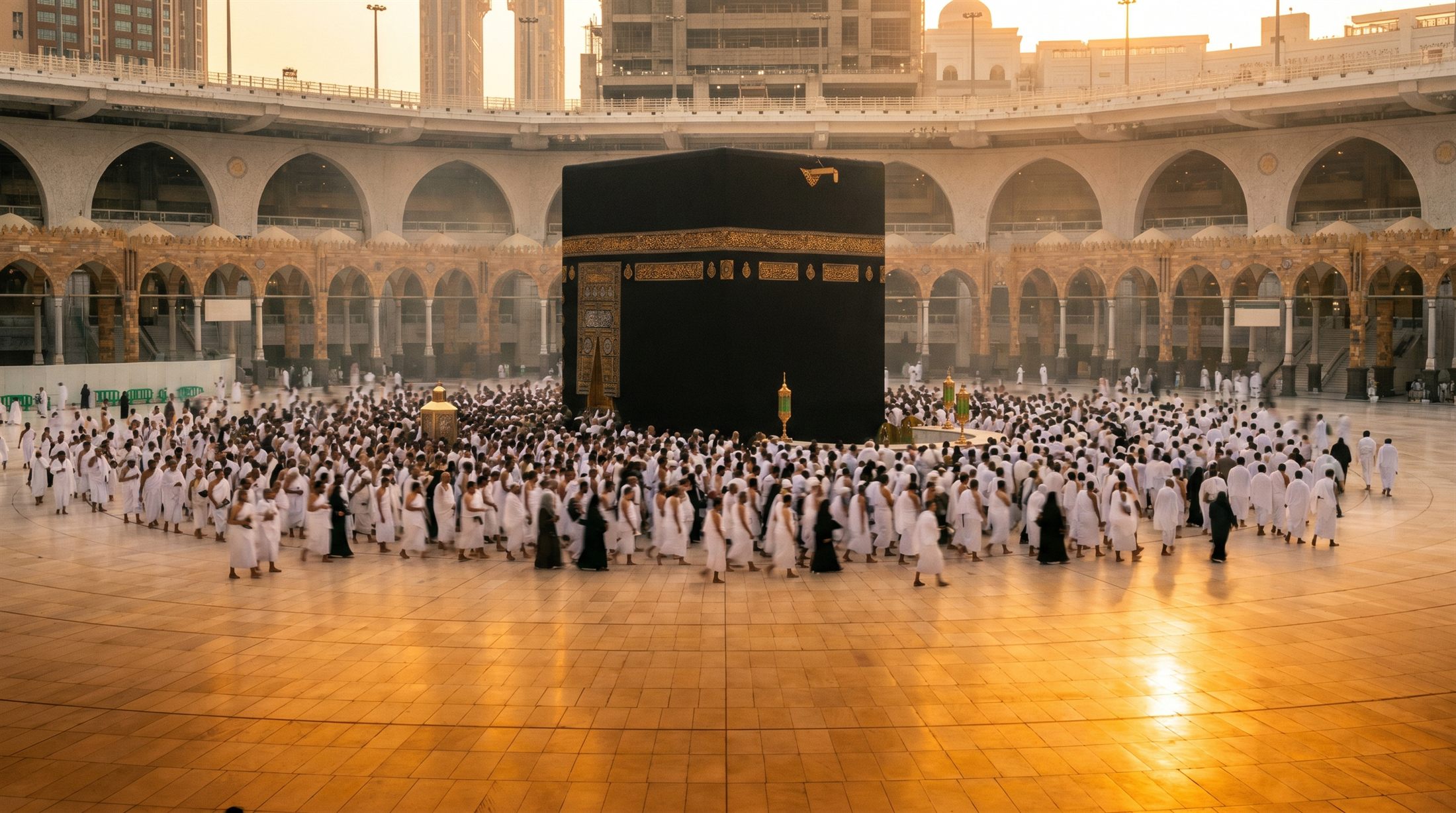
Tawaf is seven anticlockwise circuits of the Kaaba, beginning and ending in line with the Hajar al-Aswad (the Black Stone). A green light on the wall of the mosque marks the starting line. At the start of each circuit, face the Black Stone, raise your right hand towards it and say Bismillahi Allahu Akbar. Kissing or touching it is a sunnah only if you can do so without harming anyone; pushing through a crowd to reach it is not.
- Men perform idtiba' during the tawaf of Umrah: the right shoulder is uncovered by passing the rida under the right arm. The shoulder is covered again before prayer.
- Men also perform raml, a brisk walk with short steps, in the first three circuits, and walk normally in the remaining four. If the crowd makes this impossible, walk normally.
- Between the Yemeni corner (Rukn al-Yamani) and the Black Stone it is sunnah to recite: Rabbana atina fid-dunya hasanatan wa fil-akhirati hasanatan wa qina 'adhab an-nar. For the rest of the circuit, make any dhikr, du'a or Qur'an recitation you like.
- Keep count. Use your fingers, a tally counter or a companion. If you are unsure, assume the lower number.
- Wudu is required for tawaf according to the majority. If it breaks, renew it and resume from where you stopped, or restart if your scholar advises.
After the seventh circuit, cover your shoulder and pray two rak'ahs, ideally behind Maqam Ibrahim but anywhere in the mosque if that area is busy. Then drink Zamzam, which is available from coolers throughout the mosque, and make du'a.
Step 6: Sa'i
Sa'i commemorates Hajar's search for water for her son Isma'il. It consists of seven lengths between Safa and Marwah, starting at Safa and ending at Marwah; Safa to Marwah counts as one, Marwah back to Safa as two, and so on. On approaching Safa, it is sunnah to recite the verse Innas-Safa wal-Marwata min sha'a'irillah. At each hill, face the Kaaba, raise your hands and make du'a and dhikr before setting off.
Men walk briskly between the two green markers; women walk at a normal pace throughout. The mas'a has several levels, so if the ground floor is congested ask your guide about the upper floors. Wheelchairs and electric carts are available.
Step 7: Halq or taqsir
The final rite releases you from ihram. Men either shave the head completely (halq, which is more virtuous) or trim hair from all over the head (taqsir). Women cut roughly a fingertip's length from the end of their hair, in private. Licensed barbers operate near the Marwah exit. Once done, the restrictions of ihram are lifted and your Umrah is complete, by the grace of Allah.
Etiquette that makes a real difference
Small habits, big reward
- Do not push. Reaching a spot is never worth hurting another pilgrim. The elderly, the disabled and parents with children need space.
- Keep your phone away during tawaf and sa'i. Photographs can wait; this moment cannot be repeated.
- Lower your voice. Thousands of people are making du'a around you.
- Stay with your group and know your meeting point. Phone signal inside the Haram is unreliable.
Common first-timer mistakes
- Crossing the miqat without ihram. Change on the plane or before boarding if your flight goes straight to Jeddah.
- Using scented products in ihram. Check your soap, wipes and sunscreen; unscented versions are easy to find in the UK.
- Losing count in tawaf or sa'i. Count out loud with a companion if it helps.
- Reciting a "set" du'a for each circuit. None is prescribed; speak to Allah in your own words and language.
- Touching or wiping the walls of the Kaaba for blessing. The sunnah is limited to the Black Stone and, by touching, the Yemeni corner.
- Neglecting the body. Dehydration and blistered feet end more Umrahs early than anything else. Drink Zamzam, rest, and wear footwear you have already broken in.
After the rites, pray as many salah in the Haram as you can and visit the historical sites with someone who can explain them. Travelling with Al-Haramain Travels means you will do all of this alongside an experienced scholar and a team who have guided hundreds of first-timers through every step. If you are planning your first Umrah from the UK, get in touch and we will talk you through the options.

Guided Umrah journeys from the UK and Europe. Published 8 September 2026.